
Der am 2. Februar 1942 in St.Matthews (South Carolina) geborene US-amerikanische Jazz- und Blues-Gitarrist, Sänger und Komponist James «Blood» Ulmer (Bild) ist am 3. Juni 2026 in New York City gestorben. Er stand seit Ende der 1970er-Jahre wie Ornette Coleman und Ronald Shannon Jackson im Mittelpunkt des Free Funk, der den Free Jazz mit dem Jazzrock neu verschmolz. Ulmer arbeitete u.a. auch mit Hank Marr, Dionne Warwick, George Adams, Art Blakey, Paul Bley, Joe Henderson, Arthur Blythe, Pharoah Sanders, David Murray, John Zorn, Vernon Reid, Bill Laswell und James Carter zusammen. Ulmer baute auf dem elektrischen Blues mit seinen Verzerrungseffekten und verzogenen Tönen auf und überschritt gelegentlich die Grenzen der Tonalität. Der Gitarrist verwendete für seine schneidenden, ausschliesslich mit dem Daumen gespielten Klänge eine Spezialstimmung und Spezialbesaitung und behandelte sein Instrument betont perkussiv. (*)
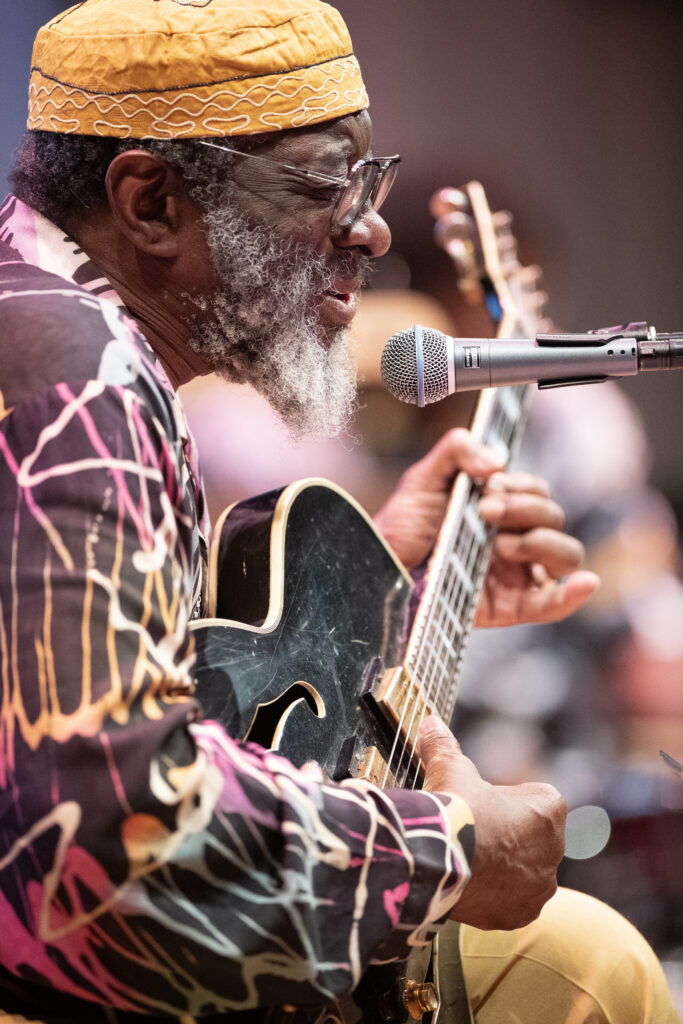
Bild: James «Blood» Ulmer, 2024 – Foto: Marek Lazarski – Lizenz: https://creativecommons.org/licenses/by-sa/4.0/deed.en – Datei: https://commons.wikimedia.org/wiki/File:0531.jpg_J.B._Ulmer.jpg
In Memoriam: James Blood Ulmer, 1940–2026
With deep sorrow and profound love, we announce the passing of James Blood Ulmer, a boldly innovative guitarist, singer, composer and beloved family member. James died peacefully on Wednesday, June 3, 2026, at the age of 86.
The Family of James Blood Ulmer
https://downbeat.com/news/detail/in-memoriam-james-blood-ulmer-19402026
James Blood Ulmer, Guitarist Who Smashed Through Genres, Dies at 86
James Blood Ulmer, whose aggressively avant-garde guitar compositions demolished the boundaries separating jazz, funk, punk, blues and even country music, earning him comparisons to Jimi Hendrix, the guitarist Wes Montgomery and his mentor, the saxophonist Ornette Coleman, died on June 3 in Manhattan.
With roots that ran deep in the gospel sounds of his South Carolina youth and the R&B he mastered early in his career, Mr. Ulmer became a fixture on New York’s downtown music scene in the 1970s, playing not just in jazz clubs but also for rock, punk and no-wave crowds.
His guitar work was explosive, propulsive and exciting. During the seven years he played with Mr. Coleman in the 1970s, he absorbed the saxophonist’s theory of harmolodics: that melody, rather than harmony or predetermined chord changes, should dictate the course of a composition.
Clay Risen
https://www.nytimes.com/2026/06/12/arts/music/james-blood-ulmer-dead.html
James Blood Ulmer Has Died
Emerging the jazz and soul clubs of South Carolina, James Blood Ulmer made his way first to Ohio, and then to New York as the 60s ended. Cutting his teeth with Art Blakey’s Jazz Messengers, his free-thinking style caught the ear of Ornette Coleman, and Ulmer subsequently became the first guitarist play with the free jazz icon.
A fascinating talent, James Blood Ulmer’s incredible technical abilities was combined with a desire to break free of any boundaries. His music was tagged free funk, and his skills termed as harmolodics, but in truth he was a complete one-off.
Robin Murray
https://www.clashmusic.com/news/james-blood-ulmer-has-died/
James Blood Ulmer, Innovative Guitarist Who Fused the Avant-Garde to Blues, Dead at 86
Applying lessons from Ornette Coleman to popular music, Ulmer was a true original
Known for a unique approach to improvisation and his warm, husky voice, Ulmer settled into a niche of his own in the late Seventies and early Eighties. Before releasing his own albums, Ulmer played electric guitar in free-jazz firebrand Ornette Coleman’s Prime Time touring ensemble.
Drawing on Coleman’s “harmolodic” music theory — essentially a group of musicians putting harmony, movement, and melody on the same plane for a transcendent sound collage — Ulmer freed the sound of guitar, playing in bursts of chords or self-divining melodies, in pop and soul contexts on his solo albums. Critics and musicians instantly recognized him as an innovator.
Kory Grow
https://www.rollingstone.com/music/music-news/james-blood-ulmer-dead-obituary-1235574837
James Blood Ulmer, avant-garde electric guitarist and singer, has died at 86
Fearlessness was fundamental in Ulmer’s music, which came firmly rooted in the blues but could often sound heat-warped, hallucinatory and feral. These qualities, along with an openness to possibility, endeared him to the free-jazz forefather Ornette Coleman, with whom he started collaborating in the early 1970s. Ulmer became the most devoted acolyte of Coleman’s concept of Harmolodics, which frees musicians from strict adherence to a key. The system, which perplexed many musicians and critics, made instinctual sense to Ulmer, who tuned each of his six strings to the same note.
Nate Chinen
https://www.npr.org/2026/06/08/nx-s1-5850695/james-blood-ulmer-obituary
James Blood Ulmer, adventurous US guitarist and vocalist, dies aged 86
Musician who spliced jazz, funk and blues, including in a spell on a major label in the early 1980s, was celebrated as ‘fearless’ by his family
Born Willie James Ulmer in South Carolina in 1940, Ulmer’s music career started out in funk bands, shuttling from Pittsburgh to Columbus to Detroit – and backed musicians such as Jewel Bryner and Hank Marr – before settling in New York in the early 1970s. “I ain’t never thought nobody could make no money playing free music,” he later said. “So I always played structured blues, rhythm playing, dance music, or something like that. And I abandoned it! When I came to New York, it was like … I just went totally another way.”
Ben Beaumont-Thomas
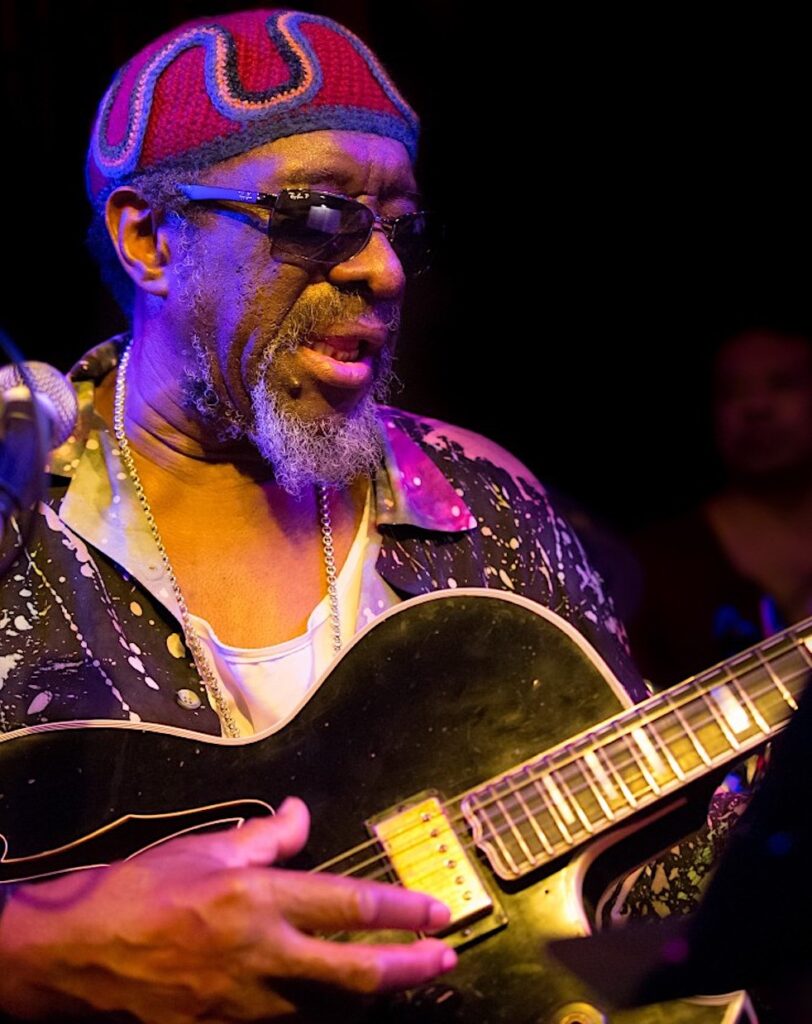
Bild: James «Blood» Ulmer, 2013 – Foto: OhWeh, https://commons.wikimedia.org/wiki/User:OhWeh – Lizenz: https://creativecommons.org/licenses/by-sa/2.5/deed.en – Datei: https://commons.wikimedia.org/wiki/File:James_Blood_Ulmer_Black_Rock_Experience_James_Blood_Ulmer_Unterfahrt-2013-01-29-001.jpg
Mort de James Blood Ulmer, libre pionnier du free funk
Eternel outsider, le guitariste et chanteur, compagnon de route du saxophoniste Ornette Coleman, mêlait singulièrement free jazz, funk et punk.
Etes-vous heureux d’être en Amérique? Cette question posée en 1980 par James Blood Ulmer reste on ne peut plus d’actualité. Tout comme sa musique demeurera gravée pour l’éternité comme l’une des voix dissonantes au pays du blues. La musique dite «du diable» fut la matrice du natif de Caroline du Sud, en 1940, dont on vient d’apprendre le décès le 3 juin, lui qui entendait être un «musicien émancipé des formes classiques posées par des siècles de domination culturelle européenne». Tel était le message qu’il faisait passer voici vingt ans sur le bien nommé «Birthright», un album en solitaire qui sonne désormais comme un joyau testamentaire. Le guitariste y trempait ses riffs dans l’acide post-psychédélique et sa plume dans le bain d’un blues ésotérique.
Jacques Denis
«Jazz is the Teacher, Funk is the Preacher»
Dem deutschen und europäischen Publikum bleibt James Blood Ulmer durch zahlreiche Festival- und Clubauftritte in Erinnerung. Legendäre Liveauftritte (wie seinerzeit sogar im Osten der Stadt, auf der Jazzbühne Berlin), Plattenproduktionen (beispielsweise bei Moers Music) und die jahrzehntelange regelmäßige Präsenz in Europa hinterließen auch in der hiesigen Jazzszene prägende Spuren.
Frank Schindelbeck
NO WAVE! Der Gitarrist James Blood Ulmer ist gestorben
James Blood Ulmers Gitarrenstil war absolut eigenständig – und oft auch eigenartig. Mit seiner Gibson Super 400 oder der Gibson Byrdland erzeugte er kantige, seltener auch leicht angezerrte Sounds mit WahWah-Einsatz. Die Saiten schlug er meist sehr perkussiv mit dem Daumen an, und er bevorzugte teils skurrile offene Stimmungen, darunter das von Ornette Coleman inspirierte „Harmolodic Tuning“. Dabei waren oft mehrere Saiten auf denselben Grundton gestimmt, andere in Quinten- bzw. Quarten-Abstand: E-A-E-A-E-E oder A-A-A-E-A-E waren solche Konstrukte. Aber auch der Blues, angezerrte Sounds, eigenwillige Bendings und geräuschhafte Einlagen prägten sein Spiel. Alles schwer zu beschreiben, und talking about music ist bekanntlich like dancing about architecture.
Lothar Trampert
Audios / Videos:
Music Revelation Ensemble – No Wave (Full Album), 1980
James «Blood» Ulmer – Free Lancing, 1981
James «Blood» Ulmer – Are You Glad To Be In America?, 1983
James Blood Ulmer – Solo 2021 (Porgy & Bess, Vienna)
James Blood Ulmer – Montreux 1981
Mehr:
https://web.archive.org/web/20091027075718/http://geocities.com/BourbonStreet/Quarter/7055/Ulmer/
https://web.archive.org/web/20150228012122/http://www.trouserpress.com/entry.php?a=james_blood_ulmer
https://www.furious.com/perfect/bloodulmer.html
https://www.allmusic.com/artist/mn0000114031
https://en.wikipedia.org/wiki/James_Blood_Ulmer
(*) https://de.wikipedia.org/wiki/James_Ulmer
#JamesBloodUlmer #CHcultura @CHculturaCH ∆cultura cultura+





Kommentare von Daniel Leutenegger