
Sixty-four journalists and other media workers were killed world-wide because of their professional activities in 2011, with nearly half of them killed in Pakistan, Iraq, Libya and Yemen, the World Association of Newspapers and News Publishers (WAN-IFRA) said Thursday.
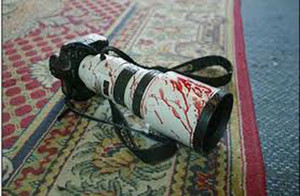
Photo: © JK image – WAN-IFRA
Ten journalists were killed in Pakistan for the second consecutive year, making it again the most deadly country for journalists.
The Arab region was the world’s most dangerous region for media professionals, with twenty-two journalists killed. The brutal repression that followed widespread popular uprisings in Bahrain, Egypt, Libya, Syria, Tunisia and Yemen cost the lives of sixteen journalists. Journalism in Iraq remains a dangerous profession, as six journalists lost their lives in the country last year.
Mexico remains the most dangerous country for journalists in the Western hemisphere, with six journalists in 2011, as coverage of organised crime and corruption have put journalists in the line of fire.
The 2011 death toll, released after an investigation into all potential media murders, compares with 66 killed in 2010, 99 killed in 2009, 70 killed in 2008, 95 killed in 2007 and 110 killed in 2006.
The full lists can be found at http://www.wan-ifra.org/microsites/journalists-killed
Though many journalists are killed covering war and conflict, they’re also targeted and murdered in many countries for investigating organised crime, drug trafficking, corruption and other crimes. They are often killed with impunity, with nobody brought to justice for the murders in the majority of cases.
«When journalists are attacked and killed merely for doing their jobs, the entire society suffers», said Christoph Riess, CEO of WAN-IFRA. «The right of all citizens to the free flow of information is diminished by these acts. These murders must be prosecuted thoroughly and the perpetrators brought to justice.»
Journalists and other media workers were killed in 27 countries in 2011:
Afghanistan (2); Azerbaijan (1); Bahrain (1); Brazil (3); Colombia (1); Democratic Republic of Congo (1); Dominican Republic (1); Egypt (2); Honduras (1); India (2); Iraq (6); Libya (5); Mexico (6); Pakistan (10); Panama (1); Paraguay (1); Peru (2); Philippines (2); Russia (1); Sierra Leone (1); Somalia (3); Syria (1); Thailand (1); Tunisia (1); Uganda (1); Vietnam (1); and Yemen (6).
Several press freedom organisations track the number of journalists killed each year. The numbers vary based on the criteria used by different associations. WAN-IFRA’s figures include all media workers killed in the line of duty or targeted because of their work. It also includes cases where the motive for the killings is unsure or where official investigations have not been completed.
WAN-IFRA, based in Paris, France, and Darmstadt, Germany, with subsidiaries in Singapore, India, Spain, France and Sweden, is the global organisation of the world’s newspapers and news publishers. It represents more than 18’000 publications, 15’000 online sites and over 3’000 companies in more than 120 countries. Its core mission is to defend and promote press freedom, quality journalism and editorial integrity and the development of prosperous businesses.
cp
Contact:
Learn more about WAN-IFRA at
or through the WAN-IFRA Magazine at
http://www.wan-ifra.org/magazine
Inquiries to:
Larry Kilman, Director of Communications and Public Affairs
WAN-IFRA
96 bis, rue Beaubourg, 75003 Paris, France
Tel: +33 1 47 42 85 07
Fax: +33 1 42 78 92 33
Mobile: +33 6 10 28 97 36
E-mail: larry.kilman@wan-ifra.org





Kommentare von Daniel Leutenegger