29. April 2012
HERBERT DISTEL: «CUCKOO’S EGG – CADEAU EMPOISONNÉ»
Exposition Kunsthalle Marcel Duchamp, Cully, jusqu'au 02 juin 2012
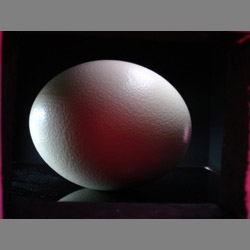
Image: © Herbert Distel
For Herbert Distel, eggs are the most universal and most numerous ready-mades in existence. When he showed his huge «Floating Egg» – formed from polyester and measuring 300 x 200 x 200 cm – at the exhibition «Premio nazionale di Scultura all’aperto in Vira Gambarogno» on the Lago Maggiore in the summer of 1968, it was torn from its moorings by a violent storm during the opening and swept away at high speed towards the Italian shore.
This
impressive incident fired his imagination and led to the realization of his
«Canaris project» in 1970. At Tazacorte on the western coast of the
Canary island of La Palma, Herbert Distel lowered his «Gigantic Egg»
into the water on 10th June 1970 and let it drift out to sea. Driven by the
constant north-east trade winds, the egg crossed the Atlantic, finally smashing
to pieces against the cliffs of the Caribbean island of Trinidad.
In the spring of 2011, over forty years later part of the support of a birdhouse in the artist’s garden, in which blue tits had been nesting only a short time before, had worked loose. Climbing up a ladder in order to repair it, Distel could not resist his curiosity and opened the door of the birdhouse, whereupon «a tiny, wonderful, intact bird’s egg fell straight into my hand.» Distel was altogether astonished and saw this occurrence as an omen of unusual significance.
Indeed, only a short time later he received ad invitation from the Kunsthalle Marcel Duchamp, the size and appearance of which bear a striking resemblance to those of a birdhouse. And since the Kunsthalle is situated not far from the Forestay Waterfall, which Marcel Duchamp photographed for his famous diorama «Etant donnés» in 1946, and the egg for Distel is not just a homage to life but also a symbol of awakening and renewal, the artist felt he could do nothing else but accept the invitation and give back to this institution the egg that had so tellingly tumbled into his hand.
It is, so to speak, the artist’s act of placing a wonderful
«cuckoo’s egg» – un cadeau empoisonné, as the French say – into the
Kunsthalle’s nest. But danger lurks: the audible «purring of a cat»
(a cat from Katzelsdorf!) in the Kunsthalle’s interior makes us all too aware
of the immanent and inevitable fate of every egg – and hence of every like and
of every ready-made …
Herbert Distel (born in Bern in 1942) is a multimedia artist working in many different creative fields, including audiovisual/audiophonic and printed media. His best-known work is The Museum of Drawers – a found cabinet with 20 drawers each containing 25 tiny rooms where he invited living artists to contribute a miniature work of art – which has been shown at many venues, including documenta 5, the Biennale di Venezia, the Bienal de São Paulo and the Museum of Modern Art, New York. Herbert Distel today lives in Katzelsdorf near Vienna.
kmd
Contact:
Kunsthalle Marcel Duchamp – Cully
Place d’Armes | Quai de l’Indépendance
CH-1096 Cully
hello@akmd.ch
http://www.akmd.ch

Beiträge von Daniel Leutenegger
-
«SCHATTENWESEN – VON DER GEISTERFOTOGRAFIE ZU DEN PHANTOMEN DES ALGORITHMUS»
-
«(MIT)EINANDER – NHU XUAN HUA UND DIE SAMMLUNG»
-
ERIC FACON STELLT DAS AUDIO-FORMAT «KULTURSTAMMTISCH» EIN
-

DER NEUE PRÄSIDENT DER STIFTUNG SCHWEIZER PRESSERAT HEISST BERNARD MAISSEN
-
RAPHAEL GYGAX WIRD NEUER DIREKTOR DES BÜNDNER KUNSTMUSEUMS CHUR

Kommentare von Daniel Leutenegger